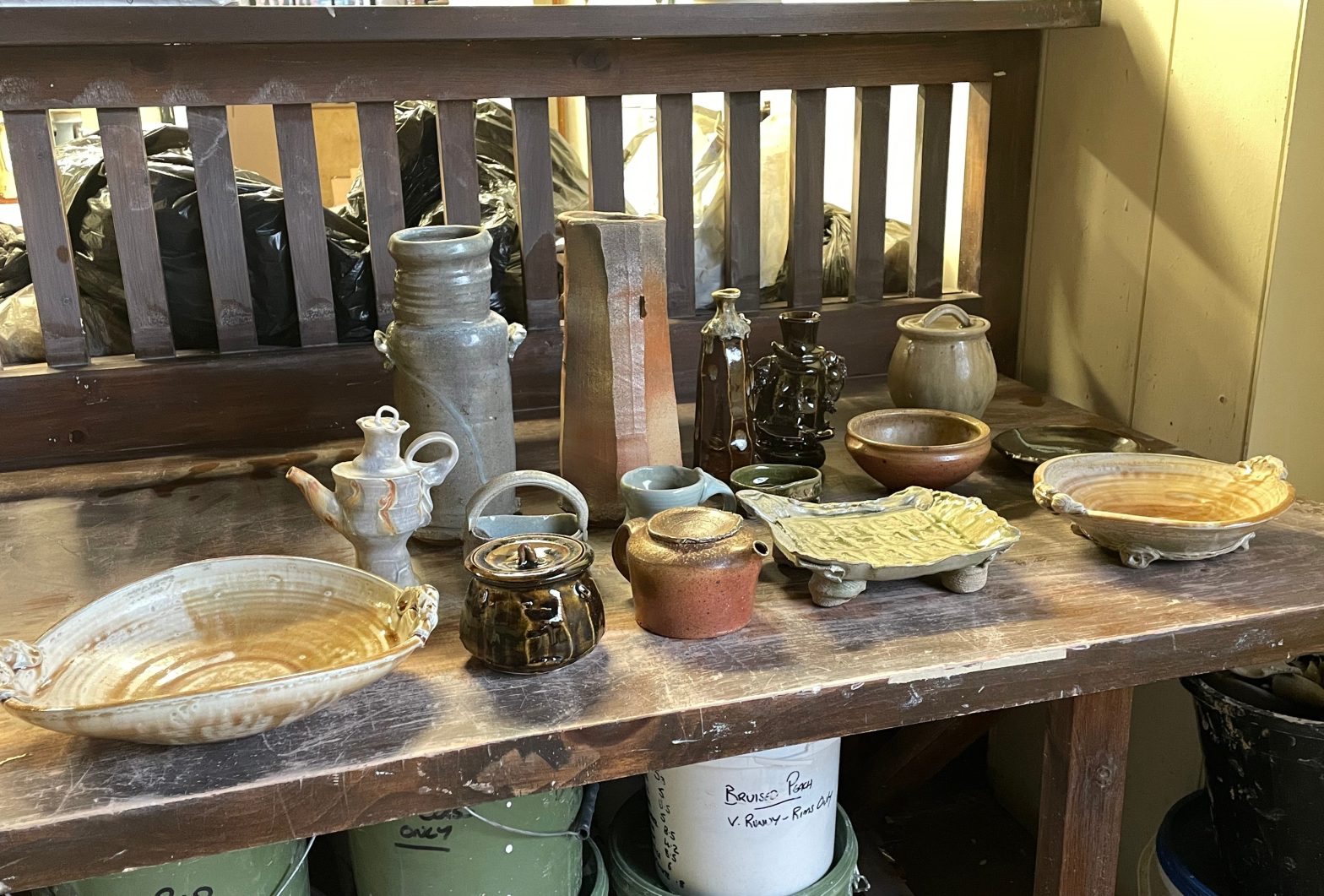
When I was at Clay College, we were encouraged to contribute to the student blog when we looked after the gallery at the weekend. I seldom wrote; I don’t enjoy writing for the sake of it, but I did write at least three posts. I am republishing them here. I sometimes find them to be a sort of time capsule for how I was thinking, and connect them deeply to the feelings I was having at the time.
Encounter
Suspended between the not-quite-spring and the surely winter’s over it’s been 6 months since the course began. An encounter I had recently was playing on my mind as I rode down the canal on my inappropriately London-ey road bike to the gallery this morning. It was on the way back to Stoke, with a delayed train meaning I found myself with an awkward wait for my connecting train in London. I tried a favourite pub of mine for a quick dinner, forgetting it was a Friday night until I arrived to the familiar ruckus of young professionals drinking away the sour taste of a week at work. No chance of a quick dinner, so I took a slow meandering walk through the back streets and on to Euston where I found a corner of the station pub and ordered myself a pint of fizzy lager. It wasn’t long before another gentleman came and sat opposite me – me on my table of 6 for one and with plenty of space around this meant just one thing; that two strangers where about to have a conversation to fill a moment of time between their comings and goings.
“Where are you headed? Not headed, just arrived.”
He was a software engineer. Monied. Or at least exuded that sort of macho self confidence that only comes from money or insecurity. He was on the way to meet someone who had been drinking all day and decided he needed to catch up a little. We spoke in the sort of cyclical stop start sort of way that occurs when two people are trying yet have little common ground. He had never met a potter, he said. Nor I, a software engineer. 6 months is a long time to be immersed in making pots. The echo chamber – to borrow a term so frequently used it has lost all meaning – of people who care about the most subtle of lines, the soft quality of the clay, the marks you make and how you as an individual comes through in your pots, is so far removed from those in the world who may come to buy them. We have a near obsessive motivation to capture that quality, but I couldn’t help but feel as though perhaps that is too abstract a quality for most people who might add a piece of hand made pottery to their world. All too easily are these marks can come across as unrefined and crass. Is it possible to be true to yourself and to the quality of the material without alienating a large portion of people ? Why would you want to position your work in such a way that it may lead to exclusion? I do not know and have no desire to do so but I do realise how easy it is to become so focused on the detail, with that focus re-radiated by peers and tutors, to the extent where we can lose site of the fact that we are making pots to be enjoyed by people, not just by potters.
The Spode site in Stoke wraps round itself and hides all manner of secrets and creative hubs. Fort Knox, it is both welcoming and off-putting simultaneously. The creative spaces stand in stark contrast to the barren and dank rooms that have been forgotten alongside them. None more than the China Halls, a sort of half relic of the corporate vision of sustainable preservation of historic spaces, with its door and awning faux-staunchly adjoined to tempt people off the street before disappointing them with a defunct expanse of prime development opportunity. But in front of these halls stands a little rose garden, that is being looked after and transformed alongside the community by artists. Yesterday I went there as they were firing a kiln full of bricks, for the garden, made by people in the community who care about the future of the public space. The tension between the inaccessible world of the site, and the public facing creativity of a small group of people got me thinking about the pottery world in general, and how we cannot wrap ourselves in our own obsessions to the degree that we entangle ourselves so much in the maze of the material that we are left with nothing but the form of an impenetrable fortress that is alien and uninviting from the outside.
I write this in the back end of the Clay College website. A world alien to me, full of code and things I do not understand; a digital labyrinth like the channels and corridors at Spode, and I find myself thinking about that software engineer. I am in his world now: I cannot see the beauty and I do not understand the desire to engage with it, know about it, or make it. And I think about pots. And how this world that we make may never be understood at all.
Some thoughts from the early days at Clay College
The changing of the seasons is often a time for renewal, and sometimes even reflection. With the bite in the air, and in entirely new surroundings, 14 of us have taken to our wheels at Clay College and immediately began a process of unlearning: taking back to basics our skills and developing them from the ground up, in an undertaking both intimidating and enthralling in equal measure. Working in earthenware for the first term, we have been developing skills of slip application, working on making series of drinking vessels and jugs, if we wish.
There is a tangible sense in the air of everything changing: set within the current geopolitical and environmental climate we know things need to change. That begins with making: learning how to make well, and then developing a practice that can fit in the world two years from now – a daunting task with the various crisis facing independent makers, and indeed, us all. Perhaps it is the sudden cold that brings this shine to the beginning of college life for me, but I can’t help but think it would be naïve to undertake something like this without keeping in your mind the bigger picture, the reality of what being a potter in the modern world will be. Yet I also feel a very deep sense of optimism. The course tutors, staff, and especially the students here are a deeply inspiring group; with the nous and sensitivity to be a positive force for meaningful change in the future.
Much will change over the next two years. Our work is going to develop at pace, and I am sure when the graduation show flings round we will be in a very different world. I hope that the many who support the college and take an interest in independent making enjoy following with interest our progress over this formative period, and I hope that the 14 of us can embody the spirit in which the college was founded and be a positive force in the potting world in the future.
Elspeth Owen at the British Ceramics Biennial
Full of strange tiny coincidences, this thing we call life. Seldom of any real significance, but almost 6 months ago to the day was the last blog post I wrote; at that time the winter was finally giving way to spring with all of the anticipation that comes with that time of year. And now here we are with the cool, dark, creeping air releasing us from the obligation of making the most of every moment of the fleeting summer, ushering in a period of focus. The second year has begun and the pace is quick. Anyway enough romantic pre-amble, it’s not as if I have some arbitrary word count to meet but I do have something that I wanted to write about, for the first time in a long time sitting in this chair in the Clay College Gallery.
I had the pleasure of meeting Elspeth Owen, one of the award artists at this year’s British Ceramics Biennial at All Saints Church in Hanley, through a friend who was helping her with the install. Her piece, photoed here, is a reflection on a lifetime of creative output, questioning what to do with it all when we come to the end of our careers. I went to hear her give a talk yesterday and was really quite moved by her words. I had met Elspeth; but I had never met ‘Material Woman’, the woman that exists without economic or state recognition and all of the freedom that comes with it, that Elspeth is when she dons her patchwork coat made from the scraps of outfits once worn by her friends. We loose things all of the time. Some things we do not care to loose, in fact some things we are happy to (Elspeth included toenail clippings in that category). Somethings we break, whether by accident or on purpose. Glass shatters with the crashing sound of inevitability, but ceramics let out a particular whine as they break that affects us in a very particular way. The sound piercing our ear, demanding our attention, leaving the bitter taste of our own carelessness that perhaps gives rise to the inevitable keeping of the piece with the well-meaning though fallacious intention that one will spend time repairing the piece at some point. And so the shards sit in some shoe-box somewhere until they’re cry out to be fixed is no longer a cry but a muted murmur that we can allow ourselves to ignore.
Elspeth’s work began by calling out for shards, and a global response created the pile upon which her pots sit, slowly decaying after being fired to bisque and drinking from the sea. The thousands of hands involved in making the pots, and the stories of how they ended up breaking, all speak to one another in forming a tense and beautiful pathway leading you in to the church (well, actually slightly disappointingly, not because that gate isn’t how you get in to the church – a missed opportunity). I had one shard in the pile, which has a story of its own which I wanted to share here.
I came to know about a village where the echos of material processing ring though the air – water powered hammers fill up until the weight of the water raises the mighty arm before it empties and smashes down on the clay below. These knocks sound day and night like wind chimes in the still air. The town produces anonymous high-fired slip-decorated pottery of a near exclusively functional nature that I find quiet; beautiful. It wasn’t until years later I had the chance to visit, doing so in 2019, and had resolved myself to buy 6 plates and 6 cups. Posting them back they miraculously survived but for one of the cups. The plates remained in daily use, moved house twice in London and then to Stoke, before one met its end at the hands of a Staffordshire Oatcake. My greedy hands sliced though the soft oat-pancake with all the excitement of an animal presented with leftovers from the table instead of the usual dry biscuits, and I rocked the footed plate which then crashed backwards towards me like one of those mighty hammers in the town of its creation: but instead of the dull melodic thud the characteristic whine of the breaking pot cut though me. I was affected more than I though I would be, I have become quite used to losing my own ceramics but I had projected some sort of symbolic meaning on those plates and their place in the many decisions I had to make before resolving to come to Clay College. I kept them and deluded myself that I would fix it at some point, but it was, to borrow Elspeth’s own words, beyond repair. Now the shards sit anonymous in the great pile of broken ware that form the foundation for Elspeth’s newly created pots. A shard from a plate that meant something to me, from the series of plates that just weeks before we all dined from after Elspeth had finished the installation, together with my good friend and extremely talented potter Rachel Kurdynowska (to whom I am very grateful for brining us all together).
Anyway, it has started raining and I have spoken too much.

 Callum Forbes